
FAQs
Dogs on Beaches and Parks Policy FAQs
- Dogs will be allowed on the orange zoned beach on-leash only before 9am and after 5pm, all year round, rather than from 4pm in winter and 6pm in summer.
- Between 9am and 5pm, dogs are not allowed in orange zoned beaches, whether on-leash or off-leash.
- Green Zones – Dogs are allowed off-leash at any time
- Orange Zone – Dogs are allowed on-leash at certain times only and prohibited at other times.
- Red Zone – No dogs allowed at any time.
- In summer (start of September school holidays to Anzac Day) before 9am and after 6pm
- In winter (the rest of the year) before 9am and after 4pm.
- Dogs will be allowed on-leash before 9am and after 5pm, all year round.
- Between 9am and 5pm, dogs are not allowed in orange zones.
- Stanwell Park Beach from the southern side of the lagoon in Stanwell Park reserve through to the boundary of the Coalcliff rock platform, approximately 80 metres east of the Kallaroo Avenue and Lower Coast Road intersection in Stanwell Park.
- Coalcliff Beach from the boundary of the Coalcliff rock platform, approximately 150 metres south/east of the Coalcliff train station, through to the Scarborough to Coalcliff rock platform boundary which is located approximately 85 metres south of the Coalcliff SLSC.
- Scarborough and Wombarra Beaches from the Scarborough to Coalcliff rock platform boundary, approximately 130 metres north/east of Jim Allen Oval, Wombarra, through to the northern side of the Wombarra rock pool.
- Brickyard Point from the southern boundary of Sharkey’s Beach, approximately 200 metres north of the Austinmer Boat Ramp carpark through to the most northern point of Austinmer Boat Ramp carpark.
- Thirroul Beach from the Austinmer Beach boundary, which is located approximately 130 metres south of the Austinmer rock pool, through to Corbett Avenue, Thirroul.
- Sandon Point Beach from the southern side of the Sandon Point SLSC through to the most northern point of the Bulli SLSC carpark.
- Bulli Beach from the southern side of the Bulli rock pool through to the northern side of the Woonona rock pool.
- Woonona and Bellambi Beaches from the Woonona rock pool through to the northern side of the Bellambi rock pool.
- Corrimal Beach from the public space area boundary, approximately 80 metres east of the Murray Road Carpark, East Corrimal through to Towradgi Pool.
- Towradgi and Fairy Meadow Beaches south from the Towradgi rock pool boundary through to the Puckey’s Beach boundary which is located approximately 150 metres from the most southern point of the Fairy Meadow SLSC carpark.
- Puckeys Estate from the entrance on Squires Way through the estate to the entrance on Elliotts Road; and ̵
- Fisherman’s Beach from the Fisherman’s Beach rock platform, south to the Port Kembla Beach.
- 6 off-leash parks, including 3 fenced parks
- 10 off-leash beach areas from Stanwell Park to Perkins Beach.
Why is Council reviewing the Policy?
The Policy is reviewed regularly. This update includes mostly formatting and editorial changes to make the document easier to read, navigate and understand.
It also included updated information about dog ownership and some proposed changes to specific beach zones.
The Policy document includes red text to make it easy to identify the proposed changes from the previous policy. In this review, we have proposed some changes that need to happen to the policy. They include:
1. Readability - formatting and editorial changes that make it easier for our community to read and navigate.
2. Orange zoned beaches - the timed access for dogs in orange zoned beaches is being simplified:
What are the zones for dog access?
The policy uses a three-tier traffic light system which is applicable to beaches. They are:
Any area not marked as green, orange, or red is considered a Public Place, where dogs are allowed on-leash at any time.
What's changing in the orange zoned beaches?
The timed access for dogs in orange zoned beaches is currently:
The timed access for dogs in orange zoned beaches is being simplified:
This would apply to the following beaches:
What about McCauley's Beach? I heard that Council was going to reduce the size of the off-leash area.
The off-leash area at McCauley’s Beach remaining as the full length of the beach. Dogs will still be allowed off-leash for the entirety of the beach
The original Policy Review had proposed that the off-leash dog area of McCauleys Beach would be reduced to just the northern section of the beach area. The reason for this was that with recent storm surges there has been significant erosion of vegetation exposing more of the environmentally sensitive rock platform at the southern end of the beach. Additionally, there exists in the proximity of the beach the Sandon Point Aboriginal Place which remains a priority for Council to protect. At the Council meeting on Monday 27 October 2025, Councillors resolved that this proposed change not be included in the Policy Review prior to it going on exhibition. The reviewed policy does not propose any changes to the area of McCauleys Beach.
Why was the section about 'Aboriginal Heritage' removed?
This section has been removed, as consultation with the Aboriginal community is a consideration in the development of the policy, and not content required in a Policy document. Council remains committed to working with our Aboriginal community to manage, protect and respond to culturally significant places.
How many off-leash areas are there in Wollongong?
Although Council’s are only required to provide one fenced leash-free area as per the Companion Animals Act 1998 No 87, Wollongong City Council already offers a range of leash-free and off-leash spaces across the city for you and your dogs to enjoy.
There are:
Most homes in the Wollongong LGA are within 5km of an off-leash area.
With around 40 dogs per 100 people in the Wollongong LGA, the policy helps ensure dogs can enjoy public spaces safely and responsibly, while protecting the environment and respecting cultural heritage.
What informs this policy?
This Policy is informed by a combination of feedback via customer requests received, feedback via Animal Compliance beach and park patrols including educational discussions with the community. Consultation has also occurred with internal Council stakeholders including Council’s Heritage, Parks and Open Space, Sport and Recreation, Environment, and Lifeguards.
The feedback heard during the engagement period will also inform the Policy Review.
How does this policy support sustainability and planning goals?
The policy, identifying a three-tier access system for our beaches, helps protect sensitive areas like dunes, wildlife habitats, and Aboriginal heritage sites by managing access for dogs in or near these areas. It also supports Wollongong’s long-term planning goals for safe, clean, and accessible public spaces.
If the changes are to go ahead as is, when would they start and how would we know?
The Policy Review will be out for feedback from the community from 5 November to the 10 December 2025. Once the engagement period finishes, the project team will consider all that was heard and change the policy if needed. It will then go to Council as a final version for endorsement.
If there are changes that will go ahead, this would be communicated with the community via Council website, education via Council’s Animal Compliance Officers patrolling beaches and parks, and updated signage.
The changes would start shortly after the adoption of the policy, however with consideration of a transition period in the areas where changes have been made.
How does Council encourage responsible dog ownership?
Council encourages responsible dog ownership firstly through education and awareness, including website information, community newsletters, in-field education, promotional material and zone explanatory signage. Council undertakes regular compliance patrols of public land, particularly enforcement on hotspot beaches and high use parks as required.
Read Owning a dog for information about dog ownership.
How will my feedback be used?
We review all the feedback we heard from the community during the engagement period. This includes online engagement like a survey, face-to-face feedback, phone calls and written submissions.
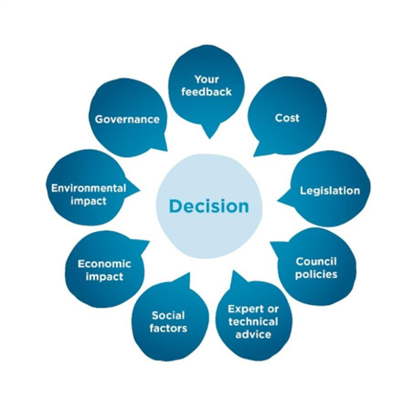
All feedback is important and is one factor in the decision-making process for Council. The graphic below shows some of the factors we consider in our decision making:
What happens next?
The Engagement Team will update the community on what was heard during the engagement period in our 'Closing the loop' update. Our 'closing the loop' updates include how many voices we heard from, key themes in the feedback collected, and what our next steps are.
Everyone who provided feedback will receive the ‘closing the loop’ update. The broader community will be notified via the engagement website.
Council will consider the feedback and resolve to endorse a final Policy, including any changes that are supported after consideration of feedback.
Future off-leash dog parks
- they provide environments that offer ‘social connection’ with other dog owners and allow dogs to socialise freely (important for dog--to dog socialisation)
- they support an environment where dog owners can exchange advice on dog management, and where responsible dog ownership principles can be promoted and reinforced
- they provide a focal point for community education and training programs.
- Council owned or managed land
- Alignment with Strategic Plan or Policy e.g. Plan of Management
- Sufficient space to accommodate an off-leash area without it unreasonably impacting on other uses, activities and facilities (current or planned)
- Conflict with other current or planned activities such as patrolled swimming areas, playgrounds and organised sporting activities etc
- Proximity to neighbouring properties and accessibility
- Current provision and proximity to existing or planned off-leash facilities
- Potential risks e.g. proximity to busy road
- Feasibility of servicing (water connections, bin servicing, carparking, fencing)
- Natural features (e.g. trees and natural shade) and environmental issues e.g. endangered ecological communities or nesting sites of vulnerable migratory and shorebirds.
- Children’s play areas: within 10 metres of playground equipment.
- Food areas: places where food is prepared or eaten, within 10 metres of those facilities.
- Recreation zones with signs: parks or sports grounds where signs clearly state dogs are prohibited.
- Public bathing spots: beaches, pools, or similar areas marked with “no dogs” signs.
- School grounds: any property used for school activities (except residences).
- Child care centres: any property used for approved child care services (except residences).
- Shopping complexes with signs: shopping arcades or complexes where signs indicate dogs are banned (not inside individual shops).
- Wildlife protection areas: areas set aside for wildlife conservation with “no dogs” signage.
Why is Council asking about possible sites for future off-leash dog parks?
There is a desire in the community for more space to safely exercise their dogs. Off-leash areas can provide the following benefits:
Are all off-leash areas fenced?
No. Council provides a variety of space including beaches, parks and designed fenced areas.
How would suitable sites for dog parks be assessed?
When reviewing potential locations for the new off-leash dog area, we will assess sites for suitability according to the following criteria:
The assessment of the sites would be considered in relevant future planning processes.
What are the places where dogs are not allowed?
As per the Companion Animals Act 1998, dogs are not permitted in certain public areas, even if they’re on a leash. These include:
I have signed a petition for a new dog park in my area. What happened to this?
Over the years Council has at times received petitions for new off-leash dog friendly spaces and parks. Some of these have been tabled at the Council Meeting. When they have been tabled, the Recreation Team as the responsible Division has investigated and responded to the main petition contact in line with Council's Submission of Petitions guideline. These petitions, like other forms of feedback, have informed the review of the Policy.
At the Council meeting on Monday 27 October 2025, Councillors resolved to ‘seek feedback from the community on sites for future ‘off leash’ dog parks or other opportunities across the city.
We have now provided an opportunity for community members to share where they believe a dog park should built. You can take a look at a map of our local government area and place a pin on the park you would like to see a dog park. Your suggestions will be considered by the relevant project teams.