Help make our next Disability Inclusion Action Plan

Share Help make our next Disability Inclusion Action Plan on Facebook Share Help make our next Disability Inclusion Action Plan on Twitter Share Help make our next Disability Inclusion Action Plan on Linkedin Email Help make our next Disability Inclusion Action Plan link

This engagement has concluded

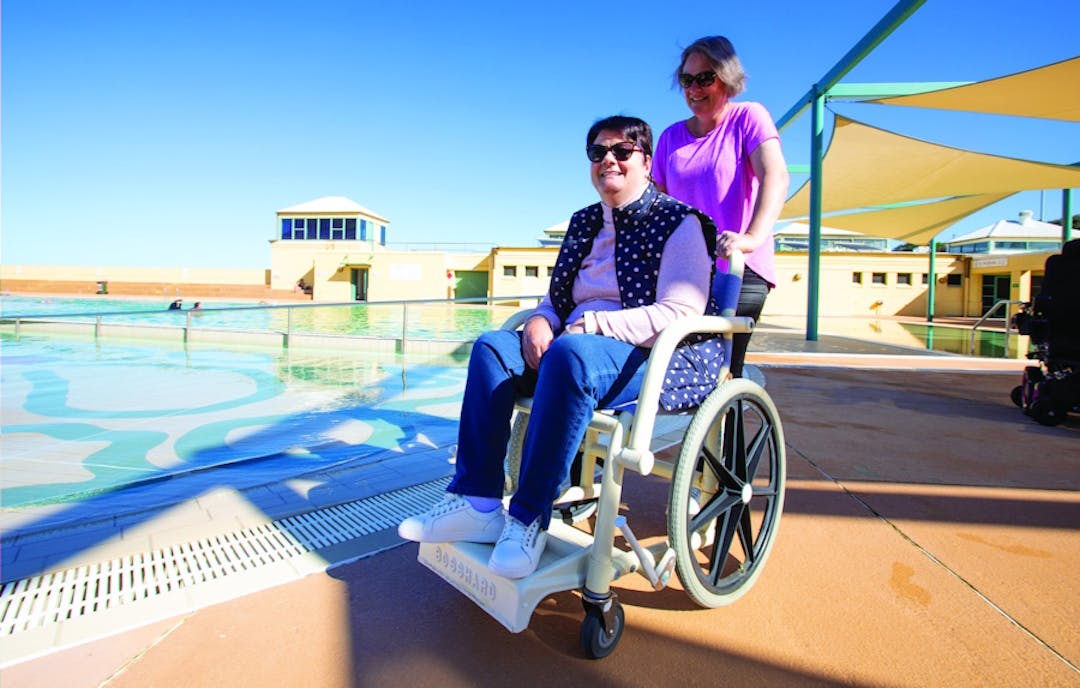
A woman pushes another woman in a beach wheelchair at Port Kembla Pool on a sunny day. Both are smiling.

We’re making our next Disability Inclusion Action Plan and want to hear from people with disability, their families, carers, and support workers. Tell us your ideas about how Council can make our community a better place for you. These ideas will help us make our Plan.

We want to know what helps – and what is hard for people with disability. You could tell us about:

  • Moving around your suburb and the places you visit.
  • Going to parks, playgrounds, beaches or pools etc.
  • Using Council services and going to events and activities.
  • What makes you feel safe.
  • What makes you feel part of our community.
  • What is easy or hard about finding or keeping a job.
  • Getting information in a way that is good for you.

There are lots of ways to share your ideas with us:

  • Come to a workshop - fill in the online form or phone 4227 7111 to let us know you want to come.
  • Talk to us at one of our pop-ups.
  • Fill in an online survey or complete a printed copy at one of our Libraries (reply-paid envelopes available).
  • Share your story or ideas online.
  • Use a Community Circle Kit to hold your own group conversation and send us your group’s feedback.
  • Email engagement@wollongong.nsw.gov.au.
  • Call us on 4227 7111 to give your feedback to our Engagement Team.
  • Write to: Engagement Team, Wollongong City Council, Locked Bag 8821 WOLLONGONG DC NSW 2500.

The final date to submit your feedback is Monday 15 September 2025.

Need help to join in?

We can provide:

  • Easy Read materials.
  • Auslan interpreters at workshops.
  • Real-time transcription for the online workshop.
  • A quiet space at events.
  • Communication boards and sensory tools.
  • Help filling in forms or sharing feedback in a way that works for you.

Call us on 4227 7111 if you need support to join in or send an email to engagement@wollongong.nsw.gov.au.

Accessibility and language support

If you’re d/Deaf, hard of hearing, or have a speech or language difficulty, you can contact us through the National Relay Service. If you need an interpreter, you can contact us through the Translating and Interpreting Service on 131 450. You’ll need to give our phone number 02 4227 7111 for either service.

Submissions become public documents and may be viewed by other persons on request. Please read Council’sPrivacy Notification before submitting your feedback.

We’re making our next Disability Inclusion Action Plan and want to hear from people with disability, their families, carers, and support workers. Tell us your ideas about how Council can make our community a better place for you. These ideas will help us make our Plan.

We want to know what helps – and what is hard for people with disability. You could tell us about:

  • Moving around your suburb and the places you visit.
  • Going to parks, playgrounds, beaches or pools etc.
  • Using Council services and going to events and activities.
  • What makes you feel safe.
  • What makes you feel part of our community.
  • What is easy or hard about finding or keeping a job.
  • Getting information in a way that is good for you.

There are lots of ways to share your ideas with us:

  • Come to a workshop - fill in the online form or phone 4227 7111 to let us know you want to come.
  • Talk to us at one of our pop-ups.
  • Fill in an online survey or complete a printed copy at one of our Libraries (reply-paid envelopes available).
  • Share your story or ideas online.
  • Use a Community Circle Kit to hold your own group conversation and send us your group’s feedback.
  • Email engagement@wollongong.nsw.gov.au.
  • Call us on 4227 7111 to give your feedback to our Engagement Team.
  • Write to: Engagement Team, Wollongong City Council, Locked Bag 8821 WOLLONGONG DC NSW 2500.

The final date to submit your feedback is Monday 15 September 2025.

Need help to join in?

We can provide:

  • Easy Read materials.
  • Auslan interpreters at workshops.
  • Real-time transcription for the online workshop.
  • A quiet space at events.
  • Communication boards and sensory tools.
  • Help filling in forms or sharing feedback in a way that works for you.

Call us on 4227 7111 if you need support to join in or send an email to engagement@wollongong.nsw.gov.au.

Accessibility and language support

If you’re d/Deaf, hard of hearing, or have a speech or language difficulty, you can contact us through the National Relay Service. If you need an interpreter, you can contact us through the Translating and Interpreting Service on 131 450. You’ll need to give our phone number 02 4227 7111 for either service.

Submissions become public documents and may be viewed by other persons on request. Please read Council’sPrivacy Notification before submitting your feedback.

Share Your Story

We want to hear what would make our community a better place for people with disability.

You can share:

🟢 Good things 

🔴 Not-so-good things

💡 Your ideas 

You can share your ideas by:

  • Writing something
  • Sharing your photos or videos 
  • Sharing links to websites, social media posts, news articles or videos. 

Examples of things you could share:

  • A great place or activity you’ve been to.
  • A good idea you think we should know about.
  • Things that could help you feel more included or safe.
  • What would make it easier for you to move around your suburb and the places you visit.
  • What would make it easier to access Council services and go to events and activities.
  • What is easy or hard about finding or keeping a job.
  • How you would like to get or share information. 

How to share your story:

  1. Give your story a title – something short that explains what it's about.
  2. Write or upload your story – add photos, videos, drawings, or links if you like.
  3. Choose if people can comment on your story.
  4. Click "Create" to send us your story.
  5. You’ll get a message to say thank you. We’ll check your story before it goes live.

You can also read other people’s stories and comment if you like.

If you need help, contact us at 4227 7111 or email engagement@wollongong.nsw.gov.au.

Thank you for sharing your story with us.

We will check your story before it goes live. We will let you know when this happens.

Have a great day!

CLOSED: This discussion has finished.

  • Share Building a Truly Inclusive Wollongong: From Access to Justice on Facebook Share Building a Truly Inclusive Wollongong: From Access to Justice on Twitter Share Building a Truly Inclusive Wollongong: From Access to Justice on Linkedin Email Building a Truly Inclusive Wollongong: From Access to Justice link

    Building a Truly Inclusive Wollongong: From Access to Justice

    by kilky18, 9 months ago

    Good Things

    Wollongong City Council has recognised disability inclusion through its DIAP 2020–2025 and provides some accessible infrastructure (e.g., ramps in newer developments, accessible beach mats in certain locations).

    Community consultations like this are positive steps, they show a willingness to listen.

    Some council services already publish Easy Read or plain language material, which is a good foundation.


    Not-so-Good Things

    Built environment exclusion: Many public buildings, shops, restaurants, and cultural spaces remain inaccessible. Current systems force individuals to lodge endless complaints under the Disability Discrimination Act, which is exhausting and ineffective.

    Transport inequity: Buses, taxis, and pathways remain inconsistent in... Continue reading

    Good Things

    Wollongong City Council has recognised disability inclusion through its DIAP 2020–2025 and provides some accessible infrastructure (e.g., ramps in newer developments, accessible beach mats in certain locations).

    Community consultations like this are positive steps, they show a willingness to listen.

    Some council services already publish Easy Read or plain language material, which is a good foundation.


    Not-so-Good Things

    Built environment exclusion: Many public buildings, shops, restaurants, and cultural spaces remain inaccessible. Current systems force individuals to lodge endless complaints under the Disability Discrimination Act, which is exhausting and ineffective.

    Transport inequity: Buses, taxis, and pathways remain inconsistent in accessibility. This creates isolation and denies the right to community participation.

    Tokenistic consultation: Disabled people are often invited into consultations but without real power to enforce change.

    Lack of safeguarding: The Royal Commission confirmed people with disability face higher rates of violence and neglect. Wollongong lacks local safeguarding hubs or independent complaints pathways.

    First Nations exclusion: Disabled First Nations people face dual discrimination but are rarely prioritised in council policy.


    Ideas for Change (Aligned with UNCRPD & Royal Commission)

    Accessibility & Infrastructure

    Conduct a mandatory city-wide access audit of council facilities, public spaces, and transport hubs.

    Require all new developments to comply with universal design principles (UNCRPD Art. 9).

    Publish an Accessible Wollongong Map covering toilets, beaches, pathways, and venues.


    Participation & Leadership

    Establish a Disability Rights Committee with majority representation from disabled people and guaranteed seats for First Nations disabled leaders (Royal Commission Vol. 5; UNCRPD Art. 4.3).

    Embed “Nothing About Us Without Us” into all council decision-making.


    Safeguarding & Safety

    Create a local safeguarding hub and peer-led complaint pathway (Royal Commission Rec. 7.2).

    Train all council staff and contractors in disability awareness and trauma-informed practice.


    Information & Communication

    Ensure all council information is available in Easy Read, Auslan, plain language, and multiple languages (UNCRPD Art. 21).

    Develop a Disability Information Portal for events, services, and crisis support.


    Employment & Economic Participation

    Adopt an inclusive hiring policy within the council (UNCRPD Art. 27).

    Partner with local disability organisations and TAFE to create supported employment pipelines.


    First Nations Disability Justice

    Formal partnerships with Aboriginal Community-Controlled Organisations (e.g., Illawarra Aboriginal Medical Service).

    Embed UNDRIP principles alongside UNCRPD to address sovereignty, cultural safety, and disability justice together.


    Closing Statement

    As a disabled person living in Dharawal Country, I want a Wollongong where accessibility is not an afterthought or a battle fought one complaint at a time. True inclusion means structural change: universal design, shared leadership, cultural safety, and safeguarding. By aligning with the UNCRPD and the Royal Commission’s recommendations, Wollongong can become a leader in disability justice, not just compliance.


  • Share Public amenities for Wentworth Street on Facebook Share Public amenities for Wentworth Street on Twitter Share Public amenities for Wentworth Street on Linkedin Email Public amenities for Wentworth Street link

    Public amenities for Wentworth Street
    by GRod, 10 months ago


    The suburb of Port Kembla has a population of approximately 5,500 people. The town centre of Port Kembla including the central roadway, Wentworth Street, does not have an accessible public toilet.

    In 2016 Wollongong City Council successfully secured a grant, as part of the Port Kembla Community Infrastructure Funds (PKCIF), to prepare the Port Kembla 2505 Revitalisation Plan. The intent was to develop a vision and strategies that would be used to direct initiatives to revitalise the suburb of Port Kembla. As part of this plan, the Council recognised clean, safe and well-located public toilets were an essential amenity that... Continue reading


    The suburb of Port Kembla has a population of approximately 5,500 people. The town centre of Port Kembla including the central roadway, Wentworth Street, does not have an accessible public toilet.

    In 2016 Wollongong City Council successfully secured a grant, as part of the Port Kembla Community Infrastructure Funds (PKCIF), to prepare the Port Kembla 2505 Revitalisation Plan. The intent was to develop a vision and strategies that would be used to direct initiatives to revitalise the suburb of Port Kembla. As part of this plan, the Council recognised clean, safe and well-located public toilets were an essential amenity that was lacking in Port Kembla. Nearly 10 years on, the Port Kembla town centre continues to be without an accessible public toilet.

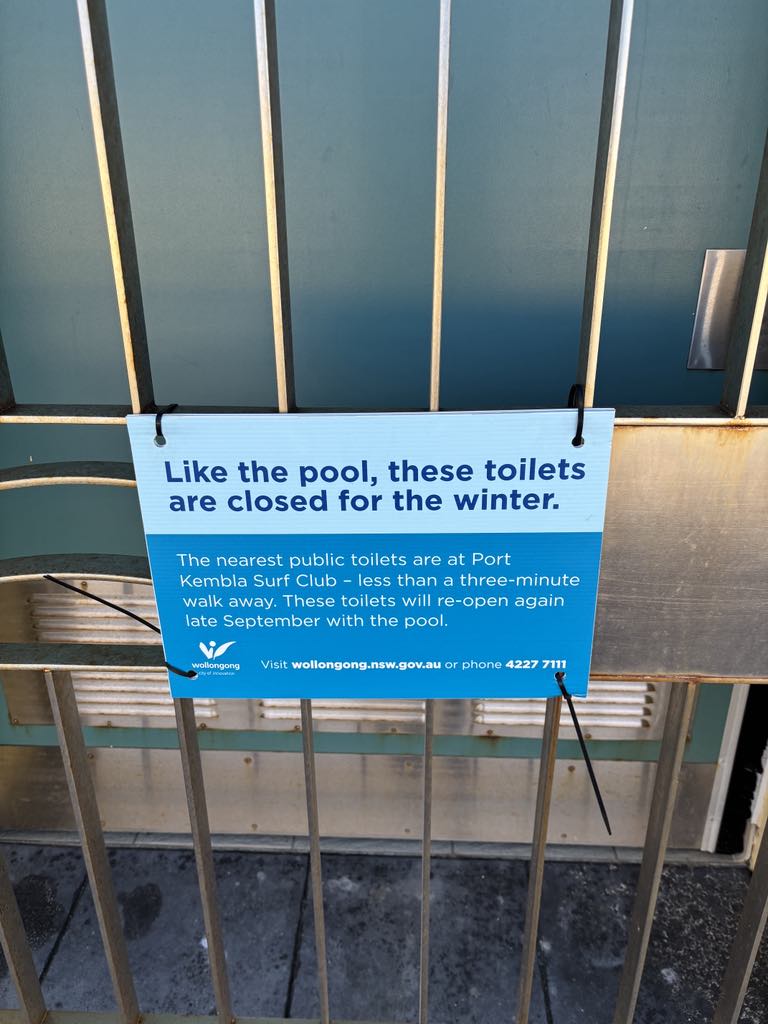
    The nearest closest accessible public toilet is located at Port Kembla Beach. Two major issues with this facility are (1) it is located almost 2 km from the Town Centre and (2) they are only open during the lifeguard season. Council refuses to consider leaving this toilet open and cleaned outside the patrol season, even though Port Kembla is one of the largest and most popular beaches on the South Coast.

    We have received reports of people who regularly urinate and, on the occasion, defecated on Wentworth Street. Parents with small kids are forced to ask local business to use their toilets and are often refused entry by the local pub when presented with no other option. Those community members with a physical, social or intellectual disability are further disadvantaged by these circumstances. Businesses and local community have been asking for this for a long time, and they feel embarrassed to tell visitors to the street there are no public toilets available.

    As a local representative of the area, we continue to receive feedback and messages from a community frustrated with the lack of response from council on this matter.

    In December 2023, a petition was introduced to Local Council December 2023 and provided to Council. The petition received the support of over 400 signatures, from local business, community and local leaders. Council advised these facilities would be considered when the budget came around. The toilet was not funded.

    In early 2024, Local Council again investigated existing external toilets including initial improvements, only to once again confirm the existing external toilet sites in Port Kembla were unsuitable for use as public toilets and, any existing toilet facilities in the area are outdated and do not meet community and industry standards. The only provision provided by Council was to provide further analysis of toilet facilities across the region over the next 12 months - council stated they are continuing to investigate opportunities for funding for the placement/access for toilet provisions within the Port Kembla Town Centre area and once identified, it will form part of the Infrastructure Delivery Program, but only in 'future years'.

    On August 2024, a submission regarding this matter was submitted to the Parliament of NSW as part of their ‘Inquiry into Public Toilets’. The submission was accepted and published as part of their inquiry.

    In November 2024, we spoke with Luke Costin (reporter) from Australian Associated Press in response to a submission. Our story was printed in paper and digital media across Australia. Today FM also made contact, and we spoke to them during their peak morning drive time about our lack of facilities. They termed a new phrase ‘No PT in PK’.

    And in May 2025, Council have again chosen not to fund a 24hr fully accessible public toilet for Port Kembla township within the Operational Plan 2025-26. Therefore, we can only confirm Council will continue to ignore the Port Kembla Town Centre and the need for a new accessible public toilet. Further to this, Council have not even considered including design for public toilets on Wentworth Street as a pathway for funding via the Port Kembla Community Investment Fund grants. We desperately need an accessible public toilet in Port Kembla’s Town Centre and request a review of our Local and State Government’s approach to our local facilities.

  • Share Make our beautiful beaches beautiful for all on Facebook Share Make our beautiful beaches beautiful for all on Twitter Share Make our beautiful beaches beautiful for all on Linkedin Email Make our beautiful beaches beautiful for all link

    Make our beautiful beaches beautiful for all
    by MVO072, 11 months ago

    I believe that we should strive to make as many places accessible for everyone as we possibly can. Currently Wollongong has 4 beaches set up for persons with mobility or disability issues and I think we should aim for more.

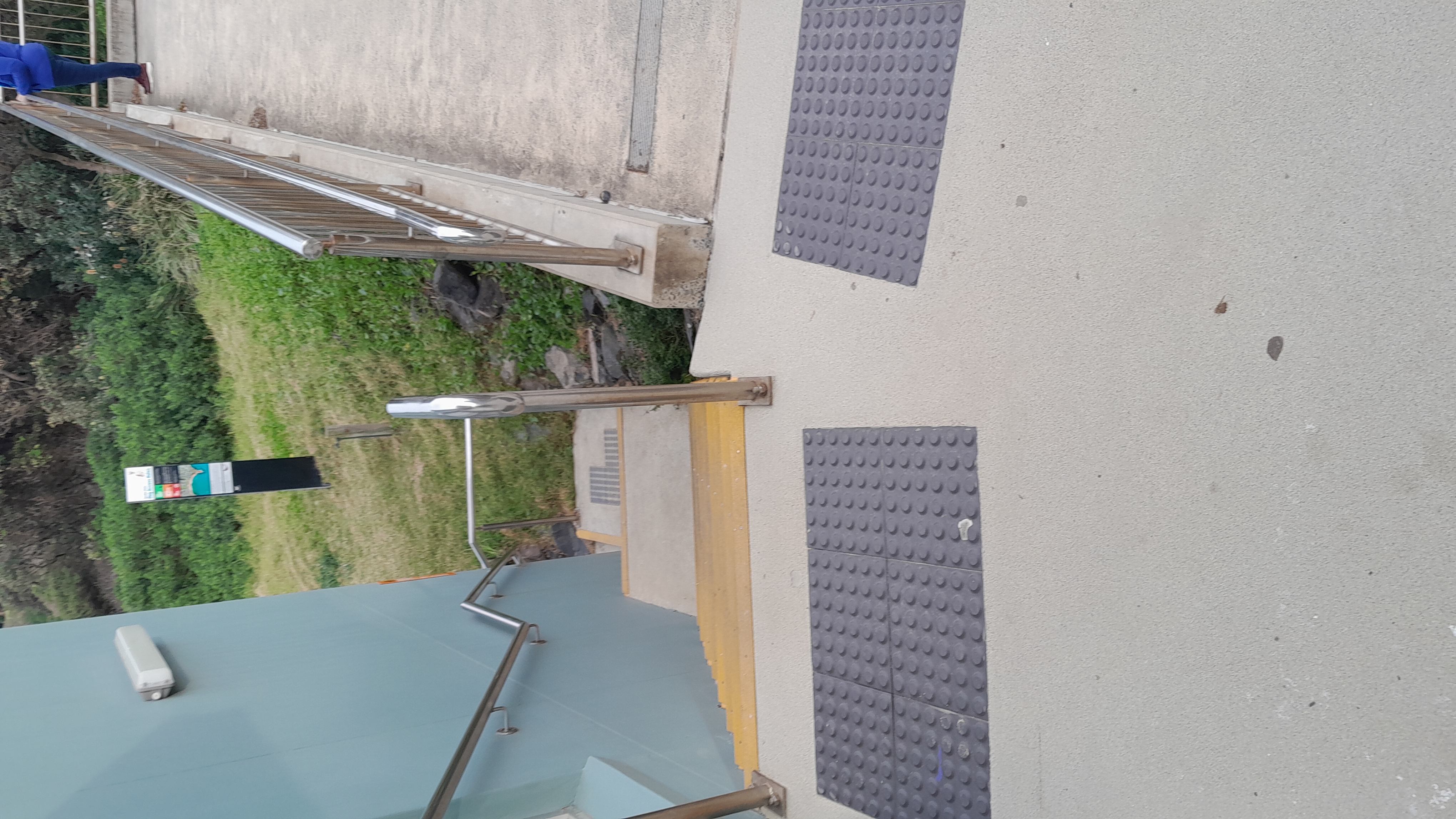
    For example Sandon Point Currently has disabled parking directly leading to accessible ramps that run for approximately 100 metres until you get to the surf club then the ramps stop and are replaced with 18 steps.

    At the bottom of the steps is a flat concrete slab that leads to toilets inc an accessible toilet. There is a viewing flatform... Continue reading

    I believe that we should strive to make as many places accessible for everyone as we possibly can. Currently Wollongong has 4 beaches set up for persons with mobility or disability issues and I think we should aim for more.

    For example Sandon Point Currently has disabled parking directly leading to accessible ramps that run for approximately 100 metres until you get to the surf club then the ramps stop and are replaced with 18 steps.

    At the bottom of the steps is a flat concrete slab that leads to toilets inc an accessible toilet. There is a viewing flatform as well and a ramp to sand but these amenities and use of are all hindered by those 18 steps.

    Another few ramps would allow access to another beautiful Wollongong beach.

    I'm sure other beaches have similar obstacles that could be engineered to allow more accessible locations.